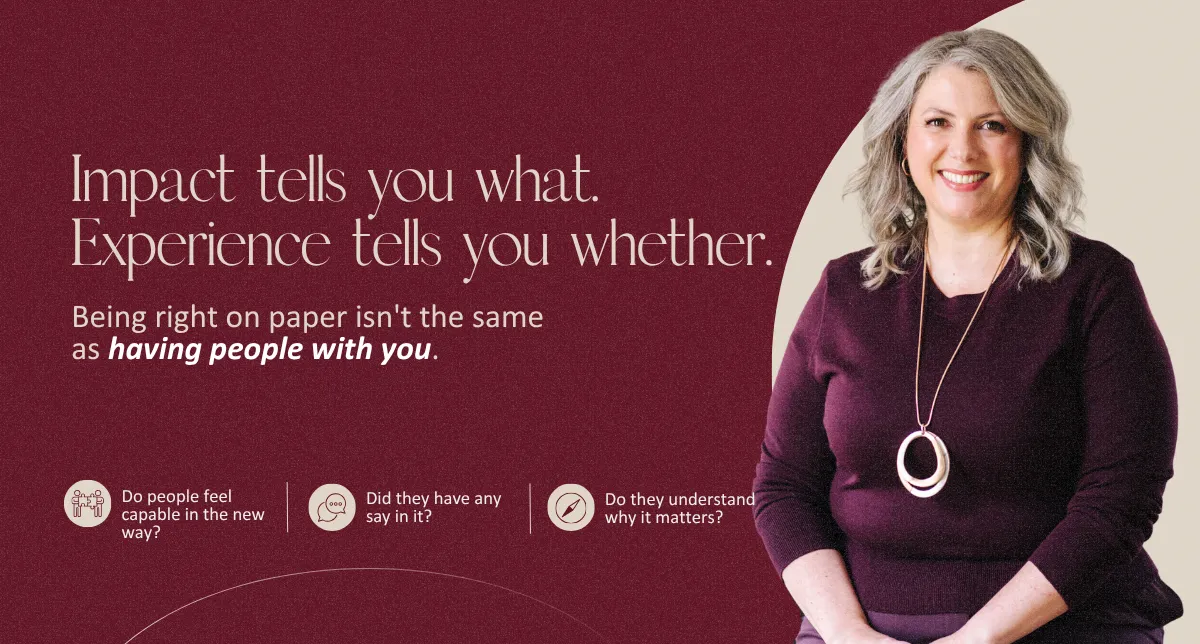
Impact tells you what's changing. Experience tells you whether it will work.
Most well-run change begins with a Change Impact Assessment. It's the piece of analysis that sets out how a change will affect people across the organisation, its systems, its processes and the behaviours it is asking them to shift, and almost everything that follows in the plan is built from it.
It's careful, necessary work, and I wouldn't run a serious change without one. But handling the impacts of a change and getting people to actually want the new way are two different jobs, and the assessment only does the first. What it can't tell you is how the change will be experienced by the people living it, and that experience, far more than the completeness of the plan, is what decides whether any of it holds.
This edition is about that gap, the one between an impact assessment that's right on paper and people who actually come with you.
You see it most clearly when the plan is complete and the people it was built for still aren't with you. Every affected group mapped, every impact assessed, the communications written, the training booked, the leaders briefed on what is coming, and still they've formed a view of the change before the first session begins. The plan is rarely the weak point. What shapes the result is the stance people bring to it, and that stance is set earlier than most plans account for.
It's worth looking at why, because we tend to get this the wrong way around.
Being right on paper is not the same as having people with you.
Change is experienced before it is embedded
This is one of the first principles I work from in Change Essentials. People experience a change before it's ever embedded in systems or practice. Long before the new process is in place or the new structure settles into something familiar, they've already felt the change coming, formed a view of what it means for them personally, and taken up a stance toward it. That stance is built from a few specific things:
whether they'll feel less capable in the new way
whether they had any say in it
whether they understand why it actually matters
That stance is what decides whether the planned activity works as intended, because the communications, the training and the engagement sessions all reach people who've already decided, consciously or not, how open they're willing to be.
The experience comes first, and everything else is received through it.
What the impact assessment actually gives you
So let's come back to the Change Impact Assessment, because it earns its place in the activities we need to do. It gives you a detailed and considered understanding of how a change affects people across the organisation, its systems, its processes, and the behaviours it's asking people to take on.
From that single piece of analysis we define almost everything that follows: the interventions, the communications, the training, the leader awareness work, the engagement activities, and the readiness and mitigation planning that sits underneath them.
Within Change Essentials this is the analytical heart of Embed Adoption, the focus area concerned with whether the organisation is genuinely ready to adopt and sustain the new way of working, rather than simply whether the delivery activities have been completed. That's the whole of the first job, handling the impacts, and it's necessary work. It's also only half of what the change needs. None of it is in question here, and none of it should be set aside.
We tend to build the plan as though people will arrive open and willing to come along, and a great deal of the time that's simply not what happens.
When the experience of the change hasn't been treated as the first thing that matters, people meet those same well-built activities already reticent, sometimes consciously and often without realising it, carrying a lens of needing the change to prove why it's better and why it deserves their energy. The training is the same training and the communication is the same communication, yet received through that lens they do far less than they should, and we're left wondering why such a well-resourced program hasn't changed how anyone actually works.
The activities aren't the problem. The problem is that they're reaching people who were never brought into the change first, and that's what decides how they're received.
Experience first is not the lighter option
Here's what I've come to trust over many years of this work. When you lead with the experience, you can do considerably less of the traditional activity and still arrive at a better result.
I've seen change done this way deliver more with fewer than half the activities a conventional method would prescribe.
The activities still mattered. What changed was the people receiving them, who were in a completely different place to begin with. When people have been drawn into the change as participants rather than recipients, when the engagement is real and the work is shaped together with them, they meet whatever activity follows from a place of willingness rather than guardedness, and the same training then works harder and the same communication carries further. You need less of it, because each piece is being received by people who are ready to receive it.
This is the heart of what Embed Adoption asks for. Adoption isn't created by the volume of activity you deliver; it's created by readiness, by clarity, by capable leadership behaviour, and by reinforcement that people are genuinely open to. An experience-led change isn't the soft version of a rigorous program, it's what allows the rigour to be worth the effort you've put into it.
Where experience belongs in the sequence
If you're a change manager, a leader driving a change of your own, or in People and Culture carrying a program right now, I'm not suggesting you set the impact assessment aside. Keep it, it's doing important work and it'll keep doing it. What I'd offer is one change to the order of operations. Before you translate those impacts straight into a list of activities, pause on the stance people are likely to bring, and shape the earliest part of their experience to meet it, so that the activities which follow are received by people who are already willing rather than braced against what's coming.
That single change in sequence, letting the experience come first and the activities follow from it, is often the difference between a program that's full of the right things and one people actually take on.
And it usually asks less of you, not more, which tends to be a real relief when you're already carrying a great deal.
What I keep seeing...
This is one of the patterns I come across most often in advisory conversations. A leadership group introduces something they've built with real care, a new framework, a process, a development program, and the people on the receiving end meet it with guardedness, or a sense that it's one more thing added to an already full plate, even when the work itself is sound and the executive group has already backed it.
When we look at it together, the gap is rarely the design.
It's how the change is being met.
The framework, handed down as another artefact to absorb, feels like weight.
That same framework, introduced as a conversation, with the senior leaders visibly doing the work alongside everyone else rather than only opening and closing the session, is received as a sign of how things are done here. The activity was the same in both cases. What changed was how people experienced it, and that's what decided whether they worked differently. This gap is easier to close than it looks, because it asks you to change how you bring people in, not to add more work.
A big part of bringing people in is being honest with them.
Most change gets sold. We list the benefits and hope people come round, but people can tell when they're being sold to, and it rarely works.
What works is the truth: why the change matters, and what it's actually going to ask of them, including the harder parts. People will go a long way for something they understand and had a hand in. They won't go far for something they were talked into.
If you can feel something is missing
If your change is busy and people still aren't with you, the Change Clarity Diagnostic will help you find out why. It works through your specific situation with you and shows you where the real gap is, whether it's in how people are being engaged, in the leadership, in the capability, or somewhere further upstream. No more guessing when the pressure is on.
You can access the Diagnostic here.
For regular notes on leading change that actually takes hold, you can subscribe to the fortnightly newsletter here.
If any of this is sitting close to something you're navigating right now, I'd really love to hear from you. Hit reply and tell me what you're seeing in your own work. I read every message, and these conversations are easily the best part of writing this.