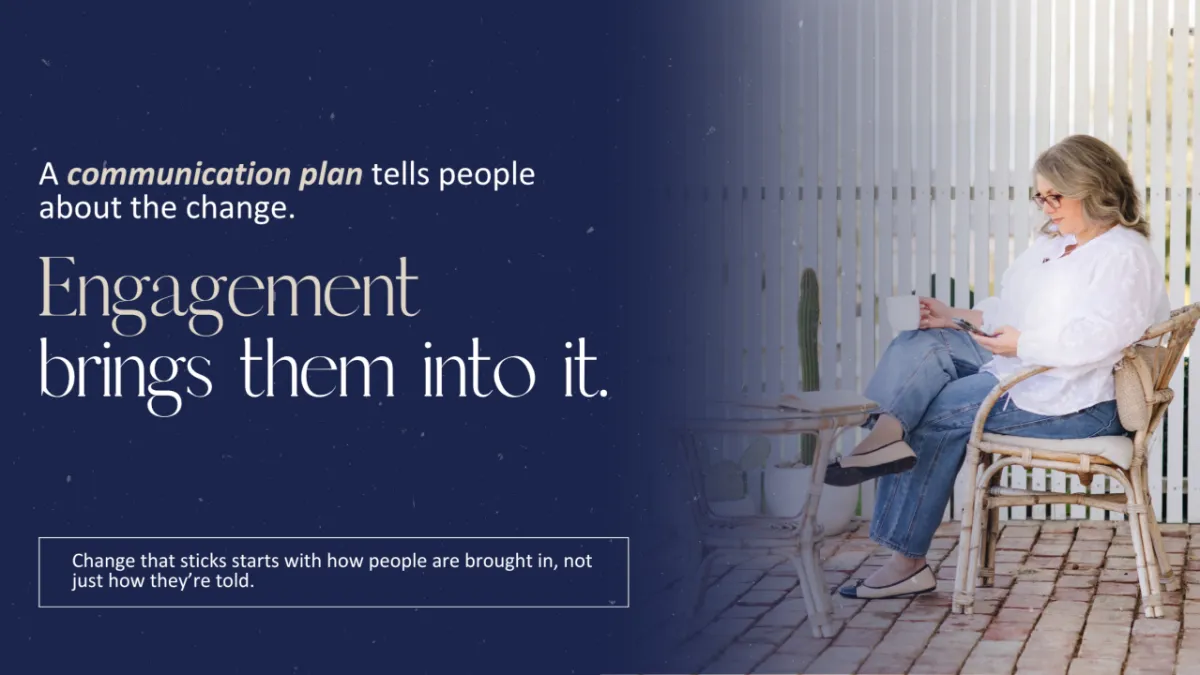
A communication plan tells people about the change. Engagement brings them into it.
There's an elephant in the room in most change planning, so let's take a red-hot second to look at it.
We map every stakeholder, sort them by how much they matter, and build a tidy schedule of who gets which email and which briefing. I've made plenty of those maps myself, so I'm not about to throw them under the bus, because they're genuinely useful. But let's be honest about what that schedule mostly is.
It's a very organised way of talking at people.
And talking at people, however polished, was never going to be the thing that brings them with you.
Engagement is a different thing entirely. It's bringing people into the change rather than informing them of it. At its fullest, it flips the whole order around. You bring the people with a stake into the room while you're still working out what the problem even is, so they help shape the solution instead of receiving it. Do it that way and you don't have to manufacture engagement later. It comes out of the work itself, because the people who'll live with the change had a hand in building it.
A communication plan, however good, never produces that on its own.
Of course, that's the ideal...
Of course, that's the ideal, and most of us don't get to live in the ideal. A lot of the time the solution is already decided before anyone's been engaged. An executive group made the call, or a handful of technical specialists did, and you're handed a finished change to implement. Even then, engagement still changes the work, because it changes where you put your effort. Less of it goes into broadcasting messages, and more of it goes into supporting your leaders to lead the change for their own teams. That's what actually moves people, and it's the part stakeholder mapping never sets up.
You see this most clearly with leaders. Stakeholder mapping hands a leader a role on the project. Sponsor, steering group member, the person who approves and endorses. What it doesn't do is set them up for the role that actually decides whether the change holds, which is leading it for their own team. So the leader ends up a recipient of the change like everyone else, when they were meant to be the one leading it.
A role on the project isn't the same as being set up to lead the change for your team.
And a leader is genuinely both. They're a recipient, so they've got to work out how they feel about the change, which often isn't all sunshine, and they need support through that. And they're a leader of it, which takes real support too, not a slide pack and a wave goodbye.
When a leader doesn't pick that second role up, it's rarely refusal, and this is where we tend to point the finger in the wrong direction.
It's usually two much more ordinary things.
The first is capacity. The urgent customer work wins every time over a change conversation that isn't due yet.
The second is discomfort. It feels awkward, they're not sure they're fully across it, they're not certain they're even behind it, and they don't have the words for the pushback they might get, real or imagined.
So it defaults to a forwarded email, or a cheerful "that's the project team's job," and the small regular things that would actually make a team ready never happen.
They were set up to nod, not to act.
The usual answer
The usual answer to all this is a leadership cascade, or a change-agent network. We brief the leaders, hand them the key messages, and ask them to pass it all down. There's no judgment here, I've built those packs myself and watched them do very little.
They only earn their keep when you put real effort into the people carrying them, so they understand the change, have their own honest story about it, and can talk to their people as a peer rather than read out a script.
What actually works
What actually works is smaller than anyone expects, which is exactly why it gets skipped.
Engagement that holds is small and regular, not one big formal announcement.
You weave the change into the meetings and conversations a leader is already having, so their team always knows what's going on instead of being hit with all of it at once.
A few examples of what that looks like:
a standing two minutes in the team meeting on what's coming and what it means for us
a real question in one-on-ones, something like "what's worrying you about this?" or "what would make it easier?"
naming what's ahead before it's official, so people hear it from their leader first and not from a project email
None of that is hard.
It feels too small to bother with, which is exactly why it never survives a busy week.
But small and regular is the whole point, because it's what takes the awkwardness out.
The change becomes a normal thing you talk about, not a moment you have to stage.
One note on tone
One note on tone, because this is where a lot of change goes soft in the wrong way.
We don't apologise for the change.
We explain why it matters and how it affects the people living it, and we respect the way they come along with it. An organisation is allowed to have expectations of its people, and that can stay as the backbone without being the headline. What doesn't work is the disingenuous middle, where "we need you to do this" gets wrapped in so much "let us make it painless for you" that nobody believes either half.
You don't have to soften the ask.
A genuinely engaged approach takes the awkwardness out on its own.
That's the whole of it, really.
Map your stakeholders, you'll need to.
Then look past the project roles and ask one more question.
Who has to lead this for their own team, and have I set them up to actually do it, or only to approve it?
If you can feel something is missing
If your change is well planned and people still aren't moving with it, the Change Clarity Diagnostic will help you find out why. It works through your specific situation with you and shows you where the real gap is, whether it's in how people are being engaged, in the leadership, in the capability, or somewhere further upstream.
You can access the Diagnostic here.
For regular notes on leading change that actually takes hold, you can subscribe to the fortnightly newsletter here.
If any of this is sitting close to something you're navigating right now, I'd really love to hear from you. Hit reply and tell me what you're seeing in your own work. I read every message, and these conversations are easily the best part of writing this.